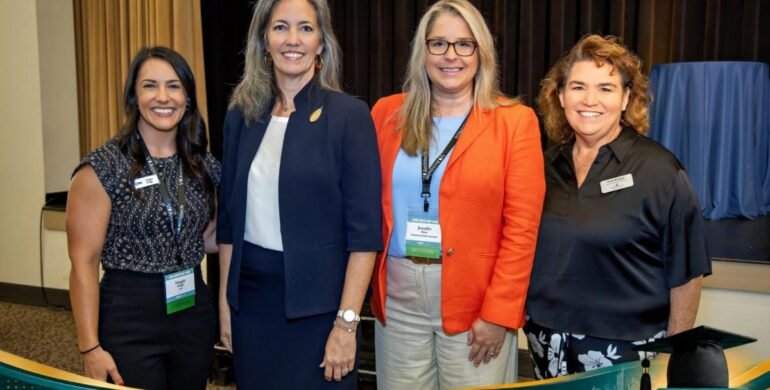
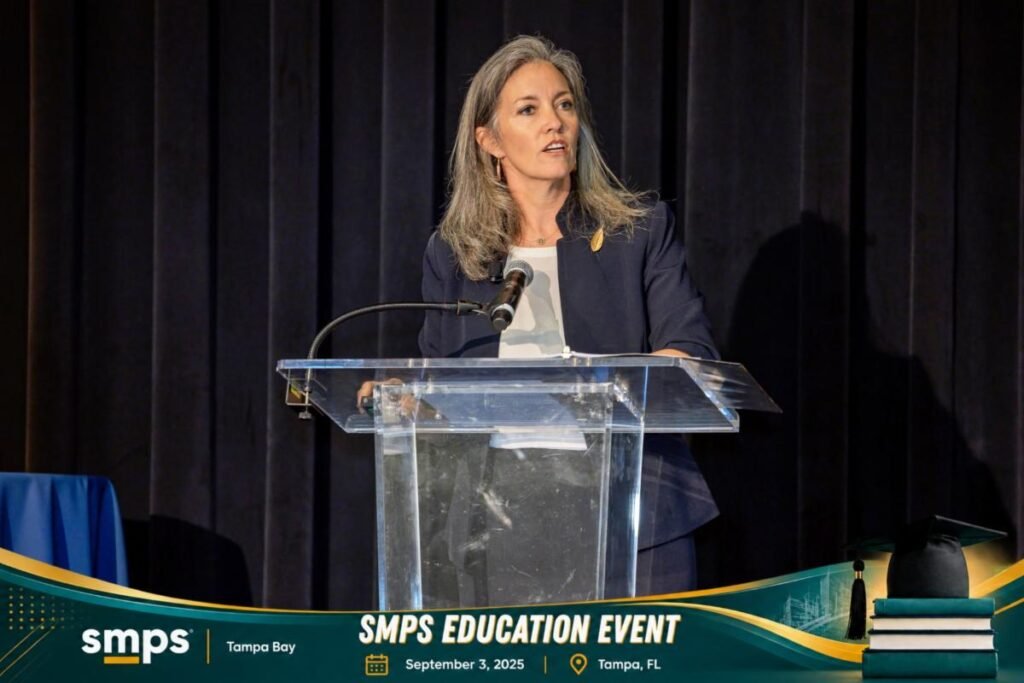
Last Thursday, I had the honor of serving as keynote speaker for the Society for Marketing Professional Services (SMPS) Tampa Bay Education Panel where I shared how policy and funding decisions are currently impacting Florida’s schools. The half-day symposium was for the AEC industry, drawing an audience of planners, designers, architects, engineers and construction professionals from across the Tampa Bay region to explore how changes in education are shaping the future of the facilities where our students learn. The built environment – design and condition of our school buildings – have a significant impact on the quality of learning and programs that can be offered.
This year, key topics of the symposium included the future of education funding, the impact of evolving education policy on facility planning, how to design resilient, future-ready campuses and how changing learning models influence physical learning environments.
I centered my presentation around the two questions that guide every conversation I have about public education: Are children learning? And are our public tax dollars being wisely invested and publicly accounted for? After a brief overview of academic performance in Florida and in Pinellas County, I discussed strategies for improving academic success, including investments in preschool, early literacy and teachers, and the need to refocus our efforts and resources on what we know works. I also spoke about how school funding has failed to keep pace with inflation and rising costs for 20 years, and what that means in practice for our teachers, students, programs and facilities.Across Florida, many districts are confronting declining enrollment, driven by a combination of factors including demographic changes, declining birth rates, affordability and shifting enrollment patterns.
That is leading to difficult conversations about school consolidation, closures and, importantly, how communities can thoughtfully repurpose public school facilities to meet changing needs. The implications of declining enrollment for school facilities were of particular interest to the architecture, engineering and construction (AEC) professionals, institutional leaders and industry stakeholders in the room.
While demographic shifts, adaptive reuse for community benefit and other built environment ideas were discussed, many of their questions focused on Florida’s K12 funding, the lack of accountability for non-public schools, how these decisions were made and what could be done to ensure public schools are appropriately funded and to ensure that all tax-funded children are learning.
Joining me on the stage for Q&A to give their county’s perspective was Patti Rendon, a Hillsborough County School Board Member. The ensuing panel included Lauren Otero, General Manager of Construction from Hillsborough County Public Schools and Scott Livernois, Manager of Facilities Design at Pinellas County Schools. Anna Corman, Chief Program Officer of the Hillsborough Education Foundation, served as moderator.
I left the symposium encouraged by the thoughtful questions and conversations happening across disciplines.
Ensuring that Florida’s students have access to excellent schools will require educators, policymakers, business leaders and communities to work together, ask hard questions about outcomes and accountability and invest in what we know works. These are exactly the conversations Educating Florida’s Future was created to advance.
If you’re interested in learning more, you can view the slides from my presentation here.
Kind regards,

Laura Hine
Executive Director
While Laura is a member of the Pinellas County School Board, these views and those expressed through Educating Florida’s Future are her own and do not represent Pinellas County Schools or the Pinellas County School Board.