
Dear friends,
May 2026 be a year of health and prosperity for you and yours.
As we dive into important work at home in Pinellas this semester as well as during the Florida legislative session, I thought I would send a few thoughts to lay the groundwork.
Reminder of #PinellasProud.
The education news and reporting that we see primarily discusses education on a state-level basis. Florida is a big state.
There are 3 things I would love for every Pinellas resident to know about Pinellas schools. I have written about each before more in depth, this is just a wave top. When I see you I will give you a quiz :).
Pinellas County leads our state and is commensurate with leading states and districts in Academic Recovery for Reading and for Math post-pandemic.
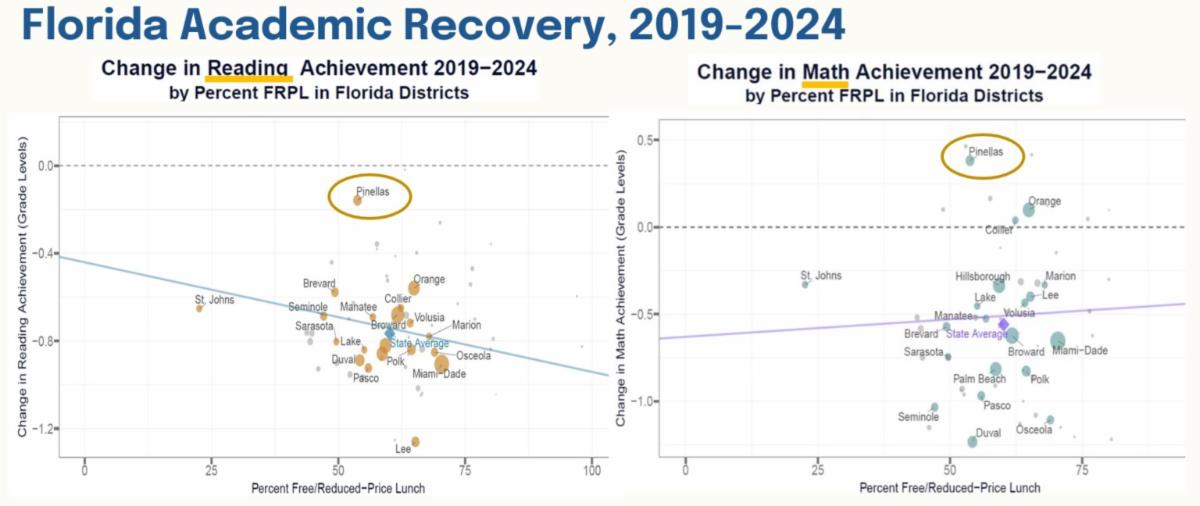
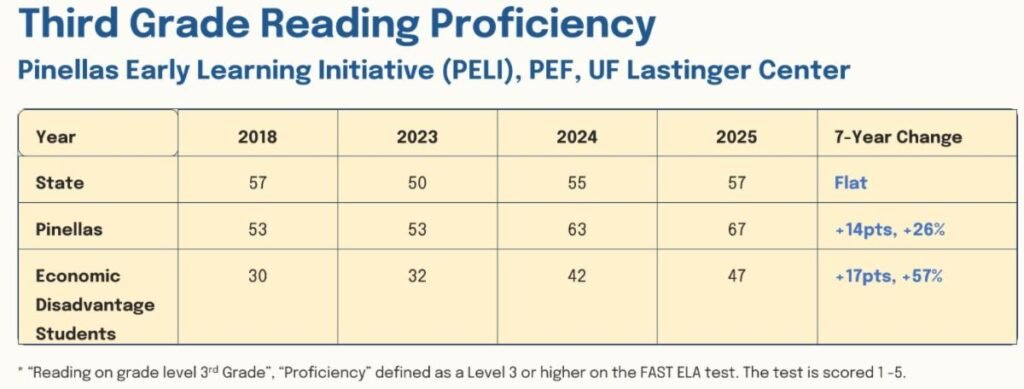
Pinellas County’s 3rd grade reading rate has increased by 14 pts (26%) since 2018. The state of Florida has stayed flat over the same time.
The 3rd grade reading rate for economic disadvantaged students in Pinellas has increased by 17 pts (57%) since 2018. Are we satisfied? No. Are we on the right track? Definitely.
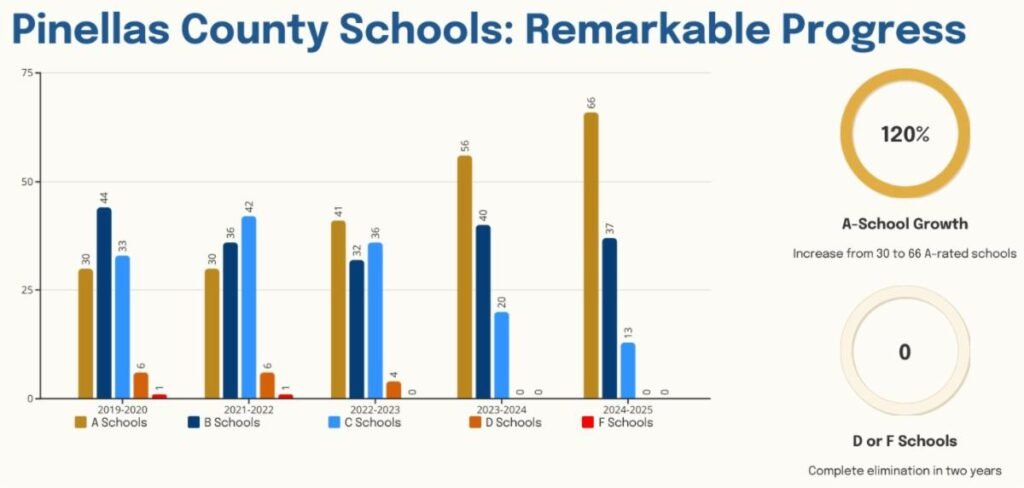
Pinellas has doubled the number of A-rated schools in the recent 5 years and has zero D or F schools.
89% of our schools are A or B schools and our graduates earn National Merit, attend every Ivy League school, military academy and state university, plus have career technical opportunities you cannot imagine if you have not seen it.
(Side note: It is popular to lament that we do not have shop in schools anymore…oh, we have shop…come see the automotive, culinary or medical programs in our schools.)
Pinellas Demographic changes: what does it mean for our schools?
Last May Pinellas County Schools graduated 6,768 seniors into the world. This year we started with 5,129 Kindergarteners – due to affordability and lowering birth rate.
Over the recent decade-plus families with young children have struggled to afford life in Pinellas County and have chosen to leave.
Couple that with the lower birth rate and there are far fewer K12 aged children in our county.
These few charts describe the trends. It is one thing to have a dip in population – you would not want to make long-term agreements or changes based on something potentially short-term.
Of note, the University of Florida’s Bureau of Economic and Business Research recently published that:
- the school-age population in Pinellas is expected to decrease or plateau through 2050, and
- the population of residents 80+ in Pinellas will double by 2050.
We are again an aging county.
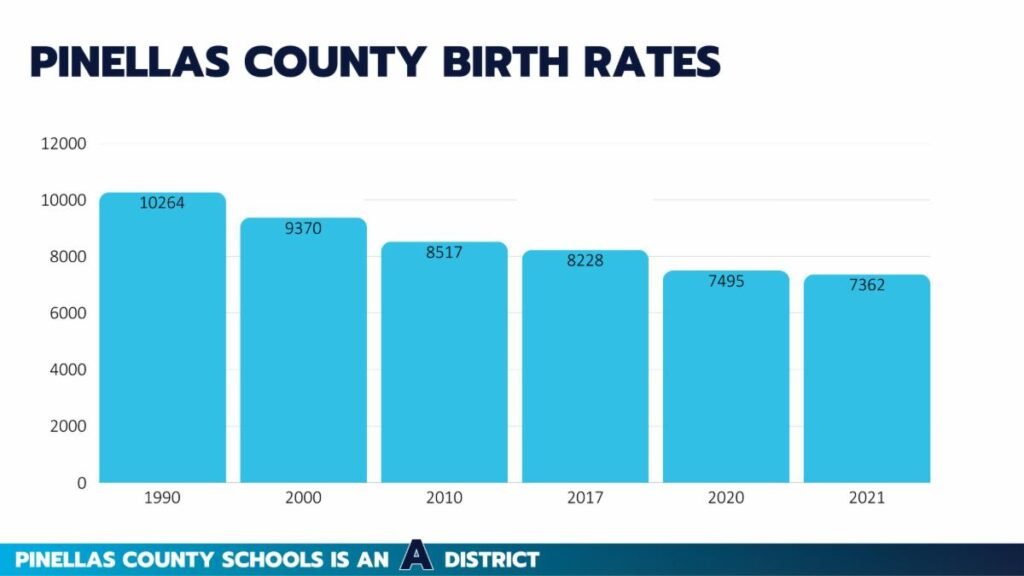
To note: Pinellas County Schools enrollment is down due to demographics. It is not down due to vouchers or school choice.
Our public schools have a net gain from private and home school each year. We have excellent schools and people choose to attend them.
That said, with the number of births and total K12 children down more than 20% and that projected to remain so, we have to look at building capacity.
When you hear in the news or online about discussions of creating K-8 schools, or combining schools, or the recommendation to sell surplus land, etc.,
Those discussions are tied to the change in Pinellas demographics and the responsible discussion that should ensue.
The goal is that any changes that might come offer a better school experience for our families, students and teachers.
Keep watching this one and be in touch with your thoughts, ideas and recommendations.
Answering a Data Question on private school accreditation.
A fellow Florida School Board member recently asked me about the statistic I share that of the 3,560 private schools in Florida 76% are unaccredited by any academic agency.
I shared with her where that data is available and I thought I would share it with you, too.
*To note, there are many excellent private schools. The fact that Florida now spends $5B on non-public schooling rightfully leads to taxpayer questions around accreditation and academic accountability.
The Florida Department of Education publishes a private school directory through the Office of School Choice.
You can pull that directory for any county or for the full state and note if schools are accredited or not, if they are for-profit or non-profit, if they are religious and which denomination, which tax vouchers they accept, etc.
The data I most recently pulled, 10/20/2025, showed statewide:
3,560 private schools, 76% unaccredited, 38% for-profit, and 51% religious.
I welcome any questions about the data I share. I care that it is accurate and will always provide sources, welcome your questions and update anything may be incorrect.
Cannot account for $270M on any given day.
If you did not see it, the opinion piece by me published in the Tampa Bay Times on 12/17/2024 touches on the Auditor General’s report on the empowerment scholarship program.
There is more to come on this, though I will note that the AG’s office said, “Whatever could go wrong with this system, has gone wrong with it.”
I share my remarks on it at the December SB meeting here, and have also posted other video and information on my Facebook page if you would like to see that.
Let’s get Sen. Gaetz’s bill on voucher reform passed this session.
n Tallahassee.
I send this off from Tallahassee as I am up here for the opening session week of committee meetings and the Florida Chamber of Commerce annual Legislative Fly-In.
I will communicate more as session continues about who/when/how you can contact the lawmakers about PreK12 education.
While I serve on the Pinellas County School Board, these writings and opinions are my own.