Dear friends,
I joined the Pinellas County School Board in 2020 and as the strategic planning, budgeting and opportunities and challenges facing our schools have risen, our school board has steadfastly led with the question: what is the impact on students?
Many Pinellas residents have asked me about what they have seen in the news in recent days regarding the U.S. Department of Education and if I think it should or shouldn’t be closed.
Before one could even start to answer that question, you must ask: what is the impact on students? This letter is my answer to that question.
First, please be reminded that the primary lead of K-12 education across Florida is our state government. The Florida Constitution in Article 9 says: “The education of children is a fundamental value of the people of the state of Florida. It is, therefore, a paramount duty of the state to make adequate provision for the education of all children residing within its borders.” The state leadership sets academic standards, accreditation requirements, accountability testing and many other tangible requirements for schools such as safety and transportation, as well as allocates state funding and redistributes local funding. State level resources accounted for 23% of Pinellas’ FY23/24 revenue; Local resources 66%; and further elaborated below Federal resources 11%.
The U.S. Department of Education interfaces with Pinellas County Schools – and therefore impacts our students – in three primary ways: 1. Funding of targeted programs, 2. Compliance with federal law, and 3. Academic performance monitoring and research.
- Funding. Although Federal resources represent the smallest portion of our revenue in Pinellas County at 11%, it is a significant sum, roughly $150M in fiscal year 23/24. The three highest funded areas in order of size are:
$53M. Food for students, school lunch and breakfast, other food programs.
$38.3M. Learning in schools that serve a significant population of economically disadvantaged students – schools where more than 70% of the students are in or close to the poverty level – this is called “Title 1”.
$29.4M. Learning for students with disabilities of all sorts – meeting the Individuals with Disabilities Education Act of 1975, I.D.E.A.. From Multiple Sclerosis and Traumatic Brain Injury to diagnosed learning or behavioral disabilities – if you have visited our Nina Harris School, you have seen this funding in action, though we have I.D.E.A. students in each of our 128 schools.
Please see the below and linked spreadsheet I made detailing the federal funding to Pinellas County in FY23/24 and its impact on our students. In addition to the programs enumerated above, you will see funding for career and technical education, Civics and English literacy, professional development, etc. One must also consider that these dollars represent the people who are implementing the work; a very rough number could be about 650 related jobs in Pinellas.
- Compliance with Federal law. Congressional Acts: 1975 IDEA mentioned above; 1965 Elementary and Secondary Education Act reauthorized in 2001 as No Child Left Behind, then reauthorized again in 2015 as Every Student Succeeds Act; 1964 Civil Rights Act and many others with legal requirements impacting education. Supreme Court decisions such as 1954 Brown vs Board of Education on racial segregation or 1969 Tinker vs Des Moines on students rights to free speech.
- The U.S. Department of Education also monitors for academic performance, amalgamates national data and produces research for the K-12 industry and the public. Please be reminded that there are not Federal academic standards themselves. That said, state level accountability and the submission of annual report cards for students in grades 3-10 along with demographic reporting and improvement plans are required by the Federal government. The primary statistical agency within the USDOE is the National Center for Education Statistics NCES; this organization analyzes input from the states and districts, conducts research on trends and provides information to the profession for use in improvement. “NAEP scores” also known as the Nation’s Report Card has been in the news a good deal recently as well; that work occurs within NCES, within the USDOE. I will share a letter on that topic soon as well, focused on Pinellas County’s performance. (Spoiler alert: it’s good news.)
What is the impact of the U.S. Department of Education on our children in Pinellas County? Funding of targeted programs, Compliance with federal law, and Academic performance monitoring and research.
One takeaway that I hope for you to have from this letter is this: Pinellas County Schools is advised of and monitoring the movement at the Federal level in the same way we do at the State level every legislative session. We routinely converse and convene with government and community partners, and we keep the impact on students and our mission of 100% student success at the forefront of everything we advocate and do.
I welcome your thoughts and questions on this and anything else to do with K12 education.
My kind regards,
*While I serve on the Pinellas County School Board, this research and writings are my own. 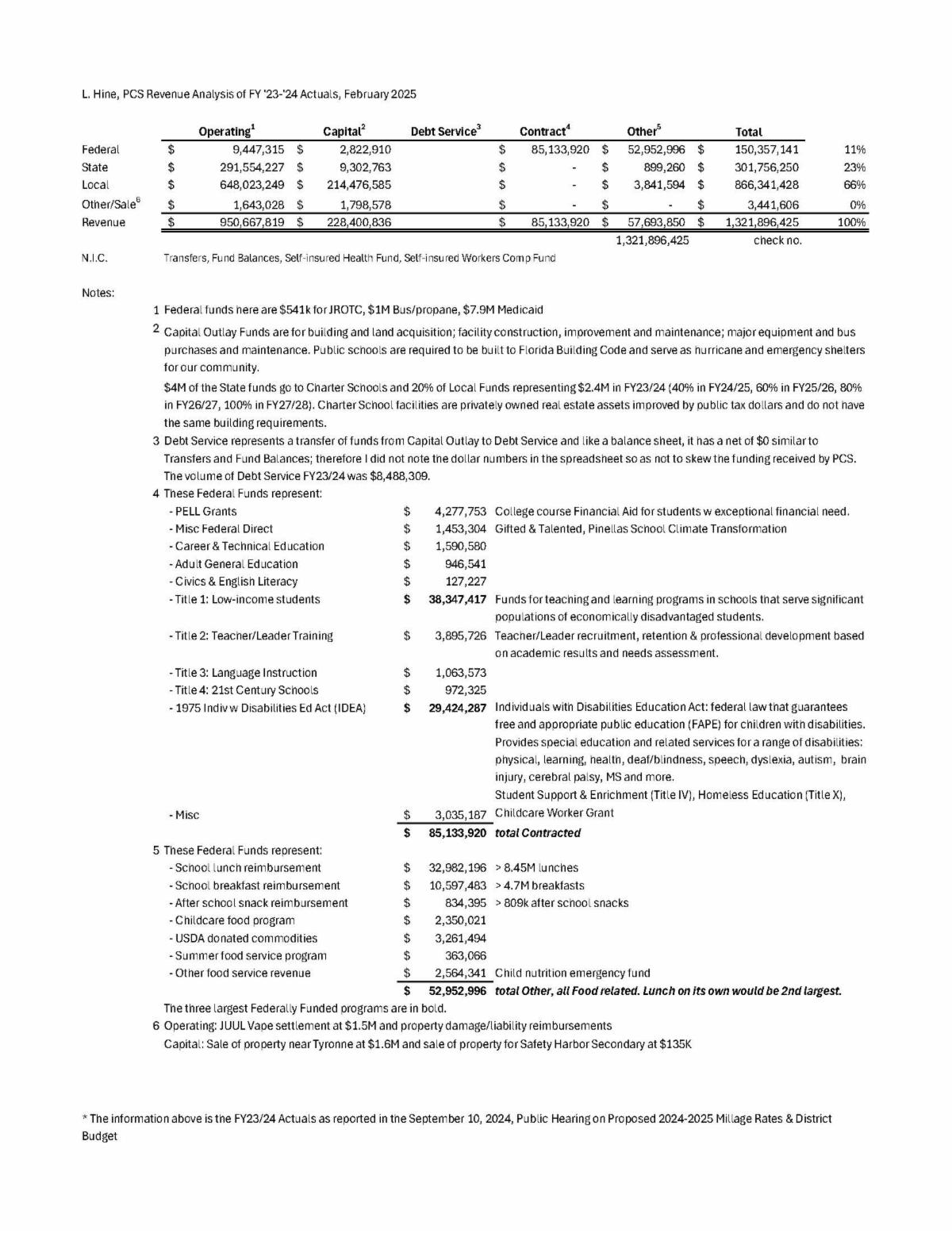
If the image is hard to read, the link to this pdf file here.